
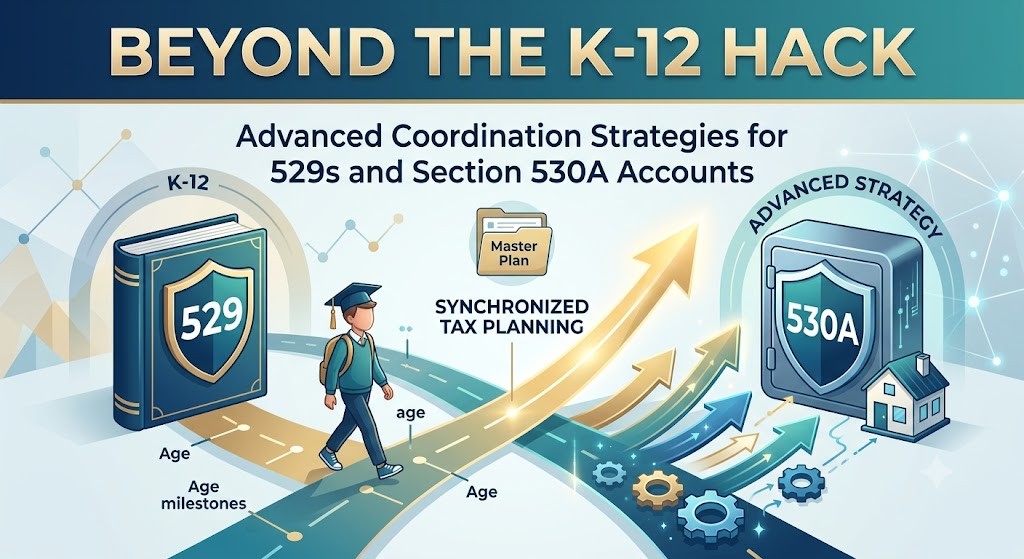
Introduction: Raising the Bar on Generational Funding
For years, affluent families have used “the K-12 private school hack”—utilizing a 529 plan to pay for up to $10,000 of elementary or secondary tuition tax-free. While useful, this is a transactional, short-term tactic.
With the arrival of tax year 2026 and the newly established Section 530A Accounts (commonly referred to as “Trump Accounts” or early-childhood savings accounts), forward-thinking families have a unique opportunity. By coordinating traditional 529 plans with these new 530A accounts, you can build a more robust, flexible wealth launchpad. This dual-engine approach maximizes tax benefits, protects family assets, and expands your legacy planning far beyond the classroom.
Understanding Section 530A Accounts: The New Kid on the Block
Enacted as part of recent federal tax legislation, Section 530A introduced a new tax-advantaged savings vehicle for children under the age of 18. To understand how to coordinate it with a 529 plan, we must first look at how they differ.
Unlike a 529 plan, which is strictly designed to fund qualified educational expenses, a Section 530A account behaves like an IRA for kids. It is designed to encourage early-life saving and investing, offering tax-deferred growth on investments during the child’s “growth period” (the years before they turn 18).
Key Rules of Section 530A Accounts:
- The Contribution Cap: Total annual contributions from all sources (parents, grandparents, friends) are limited to $5,000 per child in 2026.
- No Earned Income Required: Unlike a custodial Roth IRA, the child does not need to have a job or earned income to receive contributions.
- Investment Limitations: During the growth period, funds must be invested in low-cost, non-leveraged mutual funds or ETFs that track major U.S. stock indices.
- The Age 18 Transition: On January 1 of the year the child turns 18, the account transitions. At this point, the funds can be rolled over into a traditional or Roth IRA, or withdrawn for discretionary purposes (subject to ordinary income tax on earnings and pre-tax contributions).
The Power of Coordination: Allocating Assets Between 529s and 530As
Because these two accounts serve different long-term purposes, they should not compete for your family’s capital. Instead, they should be used in tandem to build a cohesive legacy plan.
- Target the “Low-Hanging Fruit” of Section 530A
First, secure the guaranteed benefits of the new 530A accounts:
- The Federal $1,000 Seed: If your child or grandchild was born between January 1, 2025, and December 31, 2028, they qualify for a one-time $1,000 federal pilot contribution. To claim this “free money,” you must file IRS Form 4547 with your federal tax return.
- The Employer Match / Business Owner Deduction: Employers can contribute up to $2,500 per year directly to an employee’s child’s 530A account. If you own a business, this is a highly tax-efficient way to fund your child’s or grandchild’s future. The contribution is a deductible business expense for your company and is not considered taxable income for you or the child.
- Fund the Heavy Machinery with a “Dynasty” 529 Plan
Once the 530A account is set up with its $5,000 annual limit, use the traditional 529 plan to handle the heavy lifting for college, graduate school, and estate tax reduction:
- Estate Tax Reduction: Through “superfunding,” a married couple can jointly contribute a lump sum of up to $180,000 per beneficiary into a 529 plan in a single year, immediately removing those assets from their taxable estate.
- 100% Tax-Free Distributions: While 530A withdrawals are taxable on the earnings portion after age 18, 529 plan withdrawals remain completely tax-free when used for tuition, housing, and other qualified education costs.
Tactical Playbook: How to Structure Your Family’s Strategy
To successfully coordinate these tools, wealth managers recommend a structured, multi-tier approach:
┌──────────────────────────────┐
│ Total Legacy Capital │
└──────────────┬───────────────┘
│
┌───────────────────────┴──────────────────────┐
▼ ▼
┌──────────────────┐ ┌──────────────────┐
│ Section 530A │ │ 529 Plan │
│ “Trump Account” │ │ “Education Base” │
└────────┬─────────┘ └────────┬─────────┘
│ │
├─► $1,000 Gov Seed (Form 4547) ├─► High-Limit Funding
├─► $2,500 Business Deduction ├─► Estate Exclusion
└─► Transition to IRA at Age 18 └─► Tax-Free Tuition
- Tier 1: Core Education (The 529 Plan). Build a 529 plan dedicated to covering estimated undergraduate and graduate tuition. This ensures the baseline educational needs of your family are met using 100% tax-free growth.
- Tier 2: The Wealth Launchpad (The 530A Account). Maximize the $5,000 annual contribution limit to the 530A account. Because this account can transition into a standard IRA at age 18, it is the perfect tool for funding long-term retirement, a first home purchase, or business seed capital.
- Tier 3: The SECURE Act 2.0 Bridge. If a 529 plan is overfunded, remember that up to $35,000 can be rolled over tax-free into a Roth IRA for the beneficiary, creating a clean bridge between their educational assets and their retirement assets.
Key Pitfalls to Avoid
As with any advanced wealth strategy, proper administration is critical to preserving your tax advantages:
- The Pro-Rata Withdrawal Rule on 530A Accounts: Personal contributions to a 530A account are made with after-tax dollars (creating a “tax basis”), while government, charitable, and employer contributions are pre-tax. When a child takes a withdrawal after age 18, the IRS applies a pro-rata rule. This means every withdrawal will be a mix of taxable and tax-free amounts. You cannot simply withdraw your personal contributions first to avoid taxes.
- Strict Deadlines for Section 530A: Unlike traditional IRAs, where you have until the April tax deadline of the following year to make a contribution, 530A contributions for the current tax year must be deposited by December 31st of that year.
Summary for Families
Coordinating a traditional 529 plan with a new Section 530A account allows you to create a comprehensive wealth strategy for the next generation. By using the 529 plan as your dedicated educational workhorse and the 530A account as a flexible, long-term financial launchpad, you can maximize government incentives, lower your estate tax exposure, and give your descendants a lifelong head start.
Global View Capital Management (GVCM) is an affiliate of Global View Capital Advisors (GVCA). GVCM is a SEC Registered Investment Advisory firm headquartered at N14W23833 Stone Ridge Drive, Suite 350, Waukesha, WI 53188-1126. 262.650.1030. Registration as an Investment Advisor does not imply a certain level of skill or training. Ryan Peca is an Investment Adviser Representative (“Adviser”) with GVCM. Additional information can be found at www.adviserinfo.sec.gov Global View Capital Insurance Services (GVCI) is an affiliate of Global View Capital Advisors (GVCA). GVCI services offered through Experior Financial Group, ASH Brokerage, and/or PKS Financial. GVCI is headquartered at N14W23833 Stone Ridge Drive, Suite 350, Waukesha, WI 53188-1126. 262-650-1030. Ryan Peca is an Insurance Agent of GVCI.
These views do not necessarily represent the views of GVCM or any of its affiliates. Investment involves risk. The company profile is for informational purposes only and its contents should not be construed as a recommendation. The information on this social media site alone cannot and should not be used in making investment decisions. Investors should carefully consider the investment objectives, risks, charges and expenses associated with any investment.