
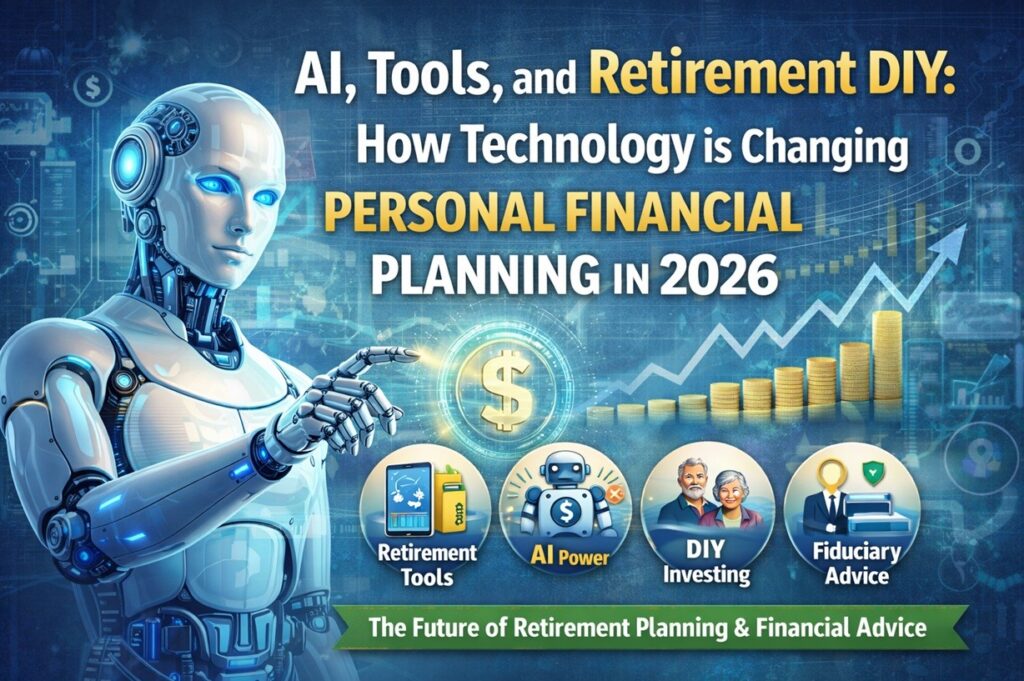
Technology is transforming nearly every aspect of our lives — and financial planning is no exception.
From AI-powered budgeting apps to robo-advisors and retirement modeling tools, individuals now have more access to financial information than ever before. What once required a professional office visit can now be done from a smartphone.
But while tools are getting smarter, retirement planning is getting more complex.
In 2026, the future of personal financial planning isn’t about choosing between technology and human guidance — it’s about knowing how to combine both effectively.
The Rise of the Retirement DIY Movement
DIY financial planning is booming.
People are using:
- AI budgeting apps
- Robo-advisors
- Retirement calculators
- Automated investment platforms
- Financial planning dashboards
- Portfolio analysis tools
These platforms empower individuals to manage money independently, track goals, and model retirement outcomes.
This shift has created a new type of investor: the digitally empowered DIY planner.
What AI Can Do Well (And Where It Falls Short)
AI and financial tools are incredibly powerful at:
Strengths:
- Data aggregation
- Scenario modeling
- Portfolio projections
- Spending analysis
- Automation
- Optimization algorithms
But AI struggles with:
Limitations:
- Behavioral coaching
- Emotional decision-making
- Risk tolerance interpretation
- Tax nuance
- Life transitions
- Legacy planning
- Complex income coordination
Retirement planning isn’t just math — it’s psychology, behavior, family dynamics, and long-term strategy.
Why Retirement Planning Is Becoming More Complex
Modern retirement isn’t just about investing.
It involves:
- Tax-efficient withdrawal strategies
- Roth conversion planning
- RMD optimization
- Social Security coordination
- Medicare IRMAA planning
- Lifetime income strategies
- Estate and legacy planning
- Healthcare cost modeling
Technology can analyze this data — but it can’t always prioritize it in the context of your life goals.
The Hybrid Model: AI + Fiduciary Guidance
The future of financial planning isn’t AI or advisors — it’s AI + fiduciary advisors.
Technology handles:
- Data processing
- Forecasting
- Monitoring
- Automation
Fiduciary advisors handle:
- Strategy
- Integration
- Judgment
- Education
- Risk management
- Behavioral coaching
- Personalization
A fiduciary financial advisor acts as the strategic filter between raw data and real-life decisions.
The Real Risk of Retirement DIY
DIY tools create confidence — but confidence without strategy can be dangerous.
Common risks include:
- Overconfidence bias
- Poor tax planning
- Improper withdrawal sequencing
- RMD mismanagement
- Emotional investing
- Lack of income planning
- No contingency planning
- No legacy strategy
Technology doesn’t replace wisdom, experience, or accountability.
How Fiduciary Advisors Are Evolving in 2026
Modern fiduciary advisors are no longer just portfolio managers.
They are:
- Financial strategists
- Tax planners
- Income planners
- Retirement architects
- Behavioral coaches
- Risk managers
- Legacy planners
- Technology integrators
They use AI and tools — but they interpret them through real-world planning frameworks.
The Smart Way Forward
The most effective retirement planning model in 2026 looks like this:
Technology for efficiency.
Fiduciary guidance for strategy.
Human judgment for decisions.
This creates:
- Better outcomes
- Lower risk
- Higher confidence
- Better long-term results
- More sustainable retirement income
- Stronger legacy planning
Why Fiduciary Guidance Still Matters
A fiduciary advisor is legally obligated to act in your best interest — not sell products, not chase commissions, and not push solutions that don’t serve your goals.
At Global View Capital Management, my focus is helping people use technology wisely — not blindly — and building retirement strategies that are sustainable, tax-efficient, and aligned with real life.
To learn more or explore your options, visit https://www.ryanpeca.com.
Final Thoughts: Technology Is a Tool — Not a Plan
AI is powerful. Tools are helpful. Platforms are impressive.
But retirement planning is still human.
The future isn’t about replacing advisors with AI — it’s about using AI to make better human decisions.
If you’re navigating retirement planning in a tech-driven world, the right question isn’t:
“What tool should I use?”
It’s:
“What strategy should I follow?”
For education, guidance, or a second opinion, visit www.ryanpeca.com.
Global View Capital Management (GVCM) is an affiliate of Global View Capital Advisors (GVCA). GVCM is a SEC Registered Investment Advisory firm headquartered at N14W23833 Stone Ridge Drive, Suite 350, Waukesha, WI 53188-1126. 262.650.1030. Registration as an Investment Advisor does not imply a certain level of skill or training. Ryan Peca is an Investment Adviser Representative (“Adviser”) with GVCM. Additional information can be found at www.adviserinfo.sec.gov Global View Capital Insurance Services (GVCI) is an affiliate of Global View Capital Advisors (GVCA). GVCI services offered through Experior Financial Group, ASH Brokerage, and/or PKS Financial. GVCI is headquartered at N14W23833 Stone Ridge Drive, Suite 350, Waukesha, WI 53188-1126. 262-650-1030. Ryan Peca is an Insurance Agent of GVCI.
These views do not necessarily represent the views of GVCM or any of its affiliates. Investment involves risk. The company profile is for informational purposes only and its contents should not be construed as a recommendation. The information on this social media site alone cannot and should not be used in making investment decisions. Investors should carefully consider the investment objectives, risks, charges and expenses associated with any investment.