
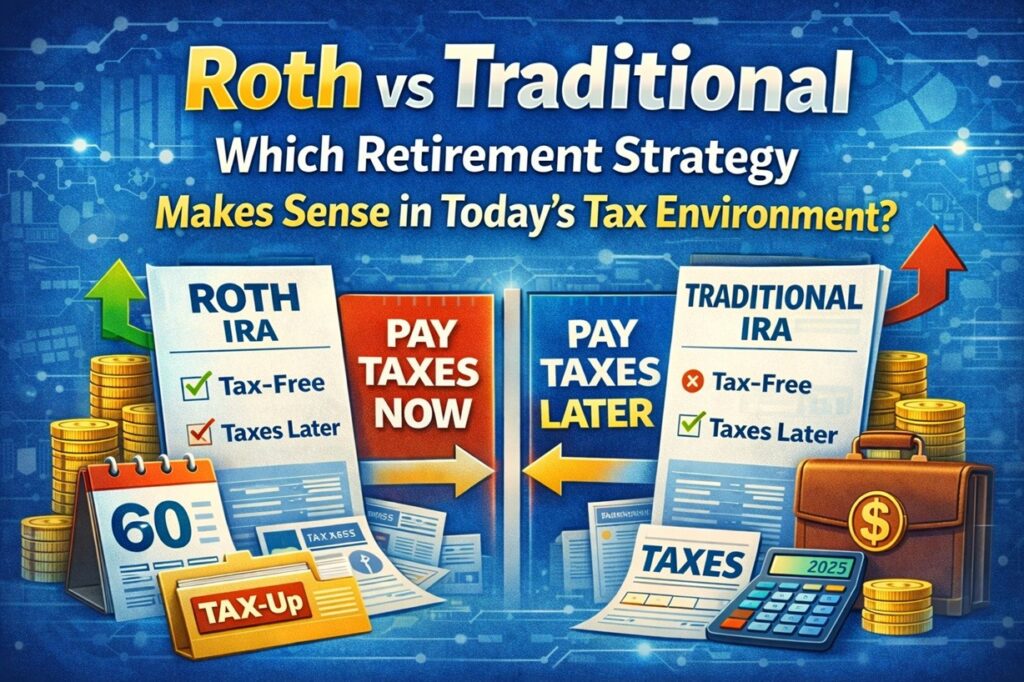
Choosing between Roth and Traditional retirement accounts has become one of the most important — and confusing — financial decisions facing today’s investors.
With evolving tax laws, higher government debt, and longer retirements, the “right” choice is no longer one-size-fits-all. Understanding how each strategy works can help you reduce taxes, improve flexibility, and create more predictable retirement income.
Let’s break it down clearly.
Understanding the Core Difference
Traditional Retirement Accounts
- Contributions are typically tax-deductible
- Money grows tax-deferred
- Withdrawals are taxed as ordinary income
- Subject to Required Minimum Distributions (RMDs) later in life
Examples:
- Traditional IRA
- Traditional 401(k)
Roth Retirement Accounts
- Contributions are made with after-tax dollars
- Qualified withdrawals are tax-free
- No RMDs during the original owner’s lifetime
- Greater flexibility for estate and legacy planning
Examples:
- Roth IRA
- Roth 401(k)
The Big Question: Pay Taxes Now or Later?
The Roth vs Traditional decision often comes down to your tax rate today versus your expected tax rate in the future.
Traditional May Make Sense If:
- You are currently in a high tax bracket
- You expect lower taxable income in retirement
- You want to reduce current-year taxes
- You plan to retire soon
- You need immediate tax relief
Roth May Make Sense If:
- You expect tax rates to rise in the future
- You are early or mid-career
- You want tax-free income later
- You want to minimize RMDs
- You want more flexibility for heirs
How Today’s Tax Environment Changes the Decision
Several factors make this decision more complex today:
- Historically Low Tax Rates (For Now)
Current tax brackets are relatively low by historical standards, but many provisions are scheduled to sunset in coming years unless extended.
That creates an opportunity to:
- Lock in today’s rates through Roth contributions or conversions
- Hedge against future tax increases
- SECURE Act & SECURE 2.0 Changes
Recent legislation has:
- Increased RMD ages
- Expanded Roth options in employer plans
- Changed catch-up contribution rules
- Encouraged long-term tax planning
These updates have made Roth strategies more attractive for many households.
Required Minimum Distributions (RMDs) and Their Impact
One of the biggest planning differences:
Traditional Accounts:
- RMDs typically begin at age 73
- Withdrawals are taxable
- Can increase Medicare premiums (IRMAA)
- Can increase taxation of Social Security
Roth Accounts:
- No RMDs for the original owner
- More control over taxable income
- Greater estate-planning flexibility
This is why many retirees focus on balancing both account types.
Roth Conversions: A Strategic Middle Ground
A Roth conversion allows you to move money from a Traditional account into a Roth account while paying taxes today.
This strategy may help:
- Reduce future RMDs
- Lower lifetime tax liability
- Create tax-free income later
- Smooth income across retirement years
Conversions are often most effective:
- Before RMDs begin
- In lower-income years
- After retirement but before Social Security
- During market downturns
There Is No One-Size-Fits-All Answer
The most effective retirement strategies often use both Roth and Traditional accounts.
Your optimal mix depends on:
- Current income and tax bracket
- Future income expectations
- Retirement timeline
- Social Security strategy
- Legacy goals
- Healthcare and Medicare considerations
This is why tax-aware retirement planning matters.
Key Takeaway: Flexibility Wins
Instead of choosing “Roth or Traditional,” many retirees benefit from having both.
A diversified tax strategy gives you:
- Control over taxable income
- Protection against tax law changes
- More predictable retirement cash flow
- Greater long-term flexibility
Frequently Asked Questions (AEO / FAQ)
Which is better: Roth or Traditional?
Neither is universally better — it depends on your current and future tax situation.
Should I switch to a Roth account?
A Roth may make sense if you expect higher taxes later or want tax-free income in retirement.
Are Roth IRAs subject to RMDs?
No, Roth IRAs do not require RMDs during the owner’s lifetime.
Can I have both Roth and Traditional accounts?
Yes. Many people use both to balance taxes.
Is a Roth conversion taxable?
Yes. Converted amounts are taxed as ordinary income in the year of conversion.
Optional Call to Action
Want help deciding whether Roth or Traditional strategies fit your situation?
A fiduciary advisor can help you evaluate tax exposure, income timing, and long-term retirement goals — before making irreversible decisions.
Global View Capital Management (GVCM) is an affiliate of Global View Capital Advisors (GVCA). GVCM is a SEC Registered Investment Advisory firm headquartered at N14W23833 Stone Ridge Drive, Suite 350, Waukesha, WI 53188-1126. 262.650.1030. Registration as an Investment Advisor does not imply a certain level of skill or training. Ryan Peca is an Investment Adviser Representative (“Adviser”) with GVCM. Additional information can be found at www.adviserinfo.sec.gov Global View Capital Insurance Services (GVCI) is an affiliate of Global View Capital Advisors (GVCA). GVCI services offered through Experior Financial Group, ASH Brokerage, and/or PKS Financial. GVCI is headquartered at N14W23833 Stone Ridge Drive, Suite 350, Waukesha, WI 53188-1126. 262-650-1030. Ryan Peca is an Insurance Agent of GVCI.
These views do not necessarily represent the views of GVCM or any of its affiliates. Investment involves risk. The company profile is for informational purposes only and its contents should not be construed as a recommendation. The information on this social media site alone cannot and should not be used in making investment decisions. Investors should carefully consider the investment objectives, risks, charges and expenses associated with any investment.