
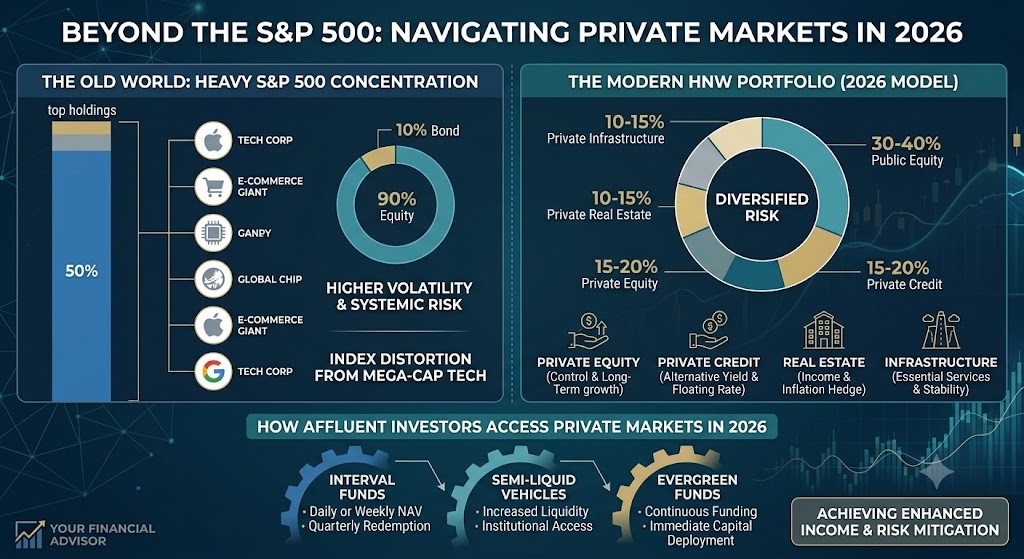
For over a decade, the playbook for individual investors was simple: buy a low-cost S&P 500 index fund, reinvest the dividends, and let the tech-driven bull market do the heavy lifting.
However, in 2026, a growing number of affluent investors and wealth advisors are coming to a startling realization: the classic, market-cap-weighted S&P 500 is no longer a diversified basket of the American economy. It has morphed into a highly concentrated, top-heavy bet on a select handful of mega-cap technology and artificial intelligence infrastructure giants.
When a retirement or legacy portfolio relies so heavily on the performance of just seven to ten companies, true diversification is lost. To manage this concentration fatigue, affluent investors are increasingly looking outside of public stock exchanges altogether, allocating meaningful portions of their wealth to private markets.
The Challenge of 2026: The Index Concentration Dilemma
To understand why alternative assets are shifting from a luxury to a necessity, one must look at the structural reality of the public markets.
In a market-cap-weighted index like the S&P 500, a company’s weight in the index is directly proportional to its market value. As mega-cap technology firms have achieved valuations in the trillions of dollars, they have consumed an unprecedented share of the index. Today, a microscopic decline in a couple of major tech stock prices can drag down the entire index, even if the other 490 companies in the index are thriving.
For high-net-worth families, this creates a major risk profile. If your personal wealth, corporate stock options, and standard brokerage portfolios are all anchored in index-based mutual funds or ETFs, you are exposed to significant, hidden overlapping risks.
Private markets offer an alternative. Because private companies do not trade on public exchanges, their valuations are tied to long-term operational performance rather than daily emotional swings or momentum-driven index buying.
The Evolution of Access: The Rise of Evergreen and Semi-Liquid Funds
Historically, accessing private equity, private credit, or private infrastructure was incredibly difficult for individual investors. The traditional “closed-end” institutional model required investors to commit capital to a fund that locked up their money for 10 to 12 years.
This traditional model is notoriously cumbersome:
- Drawdown Uncertainty: Investors do not deposit their cash all at once. Instead, managers “call” the committed capital over three to five years as they find deals, requiring investors to keep large cash reserves on standby.
- Unpredictable Distributions: When a private company is sold, cash is sent back to the investor at random times, often leaving them with idle cash that needs to be reinvested.
- Tax and Administrative Burden: Closed-end funds issue complex tax documents (K-1s) that frequently arrive late, delaying personal tax filings.
In 2026, the landscape has completely evolved. The fastest-growing segment of the alternative investment universe is the evergreen or semi-liquid fund. These structures are specifically engineered to bridge the gap between institutional private market assets and individual wealth portfolios.
How Modern Evergreen Structures Simplify Access:
- Fully Funded Investment: You make a single investment decision up front. Your capital is deployed immediately into an existing, mature portfolio of private assets, eliminating the waiting game of capital calls.
- Automatic Reinvestment: Instead of returning capital as cash when investments are realized, distributions can be automatically reinvested back into the evergreen fund. This ensures your target asset allocation remains perfectly on track and compounds continuously.
- Periodic Liquidity Windows: While private assets are inherently illiquid, semi-liquid evergreen funds offer designated redemption windows (typically quarterly or semi-annually, up to a specified percentage of total fund assets). This provides a valuable psychological and practical escape hatch if personal financial needs change.
- Simplified Reporting: Many modern evergreen vehicles are structured to provide simplified tax reporting (1099s instead of K-1s), making them vastly easier to manage within a family trust or personal taxable account.
Three Key Private Market Pillars for 2026 Portfolios
As affluent families expand their investment horizon beyond public equities, they are focusing their private market allocations across three core pillars, each serving a distinct portfolio role:
┌─────────────────────────────────────┐
│ HNW PRIVATE ALLOCATION │
└──────────────────┬──────────────────┘
│
┌───────────────────────────┼───────────────────────────┐
▼ ▼ ▼
┌──────────────────┐ ┌──────────────────┐ ┌──────────────────┐
│ PRIVATE CREDIT │ │ PRIVATE EQUITY │ │ INFRASTRUCTURE │
├──────────────────┤ ├──────────────────┤ ├──────────────────┤
│ Senior secured │ │ Direct buyouts & │ │ Real estate, AI │
│ loans, stable │ │ secondary deals, │ │ data centers, & │
│ cash flow yield. │ │ long-term growth.│ │ energy grids. │
└──────────────────┘ └──────────────────┘ └──────────────────┘
- Private Credit (Yield and Risk Mitigation)
With traditional fixed income struggling to keep pace with long-term purchasing power, private credit has become an essential income generator. These funds act as direct lenders to mid-sized private companies, negotiating senior-secured positions with protective covenants. Because these private loans feature floating interest rates, they protect portfolios against inflationary pressures and offer highly attractive, consistent cash yield.
- Private Equity Secondaries (Immediate Valuation and Diversification)
Rather than buying into a brand-new, uninvested “blind pool” of private companies, investors are utilizing secondary funds. These funds purchase existing stakes in mature private companies from institutional investors looking for early exits. This allows you to purchase institutional-grade private company exposure at a potential discount to net asset value, with full visibility of the underlying holdings from day one.
- Real Assets and Infrastructure (Inflation Defense and Secular Growth)
From modern logistics warehouses to the physical data centers and energy grids required to power the global AI expansion, private infrastructure is a core focus in 2026. These investments provide hard-asset backing, long-term contracted cash flows, and built-in inflation protection, acting as an exceptional diversifier to a standard stock-and-bond allocation.
Strategic Steps: Implementing an Alternative Asset Strategy
Transitioning a portion of your wealth into private markets requires deliberate planning and professional coordination.
Conclusion: Designing a Resilient Legacy
Relying solely on the S&P 500 means tieing your family’s financial legacy to the volatile public valuations of a tiny group of corporate giants.
By strategically integrating private credit, secondaries, and infrastructure through modern, investor-friendly evergreen vehicles, affluent families are replicating the sophisticated multi-asset strategies of major university endowments and sovereign wealth funds.
True diversification in 2026 is no longer about owning 500 stocks on a public exchange—it is about owning private assets that operate on an entirely different economic cycle.
Global View Capital Management (GVCM) is an affiliate of Global View Capital Advisors (GVCA). GVCM is a SEC Registered Investment Advisory firm headquartered at N14W23833 Stone Ridge Drive, Suite 350, Waukesha, WI 53188-1126. 262.650.1030. Registration as an Investment Advisor does not imply a certain level of skill or training. Ryan Peca is an Investment Adviser Representative (“Adviser”) with GVCM. Additional information can be found at www.adviserinfo.sec.gov Global View Capital Insurance Services (GVCI) is an affiliate of Global View Capital Advisors (GVCA). GVCI services offered through Experior Financial Group, ASH Brokerage, and/or PKS Financial. GVCI is headquartered at N14W23833 Stone Ridge Drive, Suite 350, Waukesha, WI 53188-1126. 262-650-1030. Ryan Peca is an Insurance Agent of GVCI.
These views do not necessarily represent the views of GVCM or any of its affiliates. Investment involves risk. The company profile is for informational purposes only and its contents should not be construed as a recommendation. The information on this social media site alone cannot and should not be used in making investment decisions. Investors should carefully consider the investment objectives, risks, charges and expenses associated with any investment.